In addition to the regular resources provided on this page.

We have added community resources to help everyone needing a helping hand at this time. Please feel free to reach out to the staff if you are needing assistance that may not be listed below so we can help.


The list that follows is of pantries and emergency services that are available at this time. PLEASE share this list with your students and others in need and encourage them to call the service first as changes in operating hours, etc. are occurring day to day.

Food Access Map

https://lacontroller.org/data-stories-and-maps/food-for-californians/

Shows where food pantries are located that are currently open

Project Angel Food

https://www.angelfood.org/

The grant LOVE project and Oscar de la Renta have joined forces to raise funds for a COVID-19 Emergency Food Fund. Project Angel Food’s Emergency Food Kits include three weeks of frozen and shelf stable meals

If you or a loved one has been diagnosed with a life-threatening illness and are unable to independently access healthy food, you qualify for the home-delivered meal program.


Foothill Utility Center
191 N. Oak Ave.  (Pasadena)
626/584-7420

Usually they help only residents of Pasadena and Altadena, but currently they provide food to everyone once a week.

They provide one bag of food to a family (amount depends on what the Center receives)

Tuesday 9:00a.m.-11:30.am & Wednesday 1:00pm-3:30pm.

* This is a drive through pick up


Altadena Food Pantry
943 E. Altadena Dr.  (Altadena)
626/798-1185

Union Station Homeless Services
412 S. Raymond    (Pasadena)
626/240-4550

Food Pantry- West Valley
5700 Rudnick Ave.  (Woodland Hills)
818/346-7062

MEND
10641 N. San Fernando Rd.   (Pacoima)
818/897-2443

SOVA
16439 Vanowen St.   (Van Nuys)
818/988-7682

Burbank Temporary Aid Center
1304  W. Burbank Blvd.    (Burbank)
818/848-2822

Loaves and Fishes
4322 San Fernando Rd.  (Glendale)
818/409-3080

Catholic Charities of Los Angeles-Glendale Community Services Center
4322 San Fernando Rd.                               Mon-Fri: 10:00 am – 12:00pm & 1:15-3:30 pm
Glendale                                                          Phone: (213-318-5707)

Rental and utility assistance, case management and food pantry services.

Requirements (Food):

  • Bring your own reusable bag
  • Picture I.D for applicant
  • I.D. for each member of the family (e.g. Birth Certificate, or Passport, medical cards for children)
  • Proof of address (e.g. utility bill, phone bill, or rental agreement)
  • Rent receipt
  • Proof of income (e.g. paystub, SS, SSI, Cal Works, etc.)


Salvation Army Corps Community Center- Glendale
320 W. Windsor Rd.
Glendale

http://glendale.salvationarmy.org/      
Phone:   (818) 246-5586  call for hours

Requirements:

  • Need to register for this program by filling out an application
  • Bring  ID
  • For residents of Glendale or Burbank

 *At this time not asking for proof of income as they are taking into account this emergency situation.

World Harvest Food Bank
3100 Venice Blvd
Los Angeles, CA
(213- 746-2227
Hours: Monday - Friday 8am to 6pm; Saturday 8am to 3pm


FOR RENTERS

The County’s COVID-19 Tenant Protections Resolution (formerly the LA County Eviction Moratorium), which went into effect March 4, 2020, extends certain protections to residential and commercial Tenants affected by the COVID-19 pandemic in Los Angeles County. On January 25, 2022, the Los Angeles County Board of Supervisors voted to extend the COVID-19 Tenant Protections Resolution through December 31, 2022, unless repealed or further extended by the Board. 

GCC GoPass is our new fareless public transportation program being piloted for the 2022-2023 academic year. This program encourages students to achieve their academic goals and keep momentum without the stresses of transportation fares.

The GCC GoPass program is available to all GCC students. The GCC GoPass provides GCC students with FREE unlimited rides on the following public transportation systems:

  • All LA Metro buses and rail lines (A, B, C, D, E, and L lines);
  • All Glendale Beeline buses;
  • And 12 other local municipal transit systems, including City of Commerce Transit, Culver CityBus, Foothill Transit, GTrans, LA County Shuttles, LADOT Dash, Long Beach Transit, Montebello Bus, Norwalk Transit, Pasadena Transit, Santa Monica Big Blue Bus, and Torrance Transit.

For more information about GCC GoPass, click here.

So Cal Gas

No service will be disconnected. No customer will have their natural gas turned off due to non-payment. Payment plan is required. For more information click here.

So Cal Gas Phone Number: (800-427-2200)


Glendale Water and Power

Will not disconnect electric or water services or charge late fees through April 2020 due to the customer’s inability to pay their bill. 

Starting December 1st, 2022, GWP will lift the moratorium on disconnections and late fees. GWP encourages customers to contact them for alternate payment options.

GWPCustomerService@Glendaleca.gov   (855-550-4497)


AT&T

You can apply to AT&T's Alternative connectivity program here.

Verizon

For more information on payment plans, please click here.

Charter Spectrum

Has resumed disconnections.

T-Mobile

For more information about the Federal Affordable Connectivity program, please click here

Metro by T-Mobile

For more information about the Federal Affordable Connectivity program, please click here

STUDENT LOANS

Today, the U.S. Department of Education (Department) announced a final extension of the pause on student loan repayment, interest, and collections through December 31, 2022. Borrowers should plan to resume payments in January 2023.

https://www.211la.org/

Offers a guided search by community helping you to find assistance with:

  • Food
  • Transportation
  • Healthcare
  • Mental Health
  • Crisis Services
  • Housing
  • Legal Assistance
  • Domestic Violence

https://www.unitedwaysca.org/resources/other-resources

Helps you find:

  • Food and Nutrition
  • Health Services
  • Utility Assistance
  • Employment Services
  • Shelter Services and Housing Support
  • Services for Seniors (65+)

Please click here to see the list of clinics.

2-1-1 is a free and confidential service that helps people across the U.S. and in many parts of Canada find local resources they need. It is a 24 hours a day, seven days a week hub of information.

Project Rebound, which was launched at San Francisco State University in 1967, supports the success of formerly incarcerated college students by offering the opportunity and resources needed to successfully transition and acclimate to a college campus.

The program offers special admissions for men and women who might not normally qualify for university acceptance because of application deadlines and minor academic deficiencies. This program is supported by the Associated Students and many other departments in the California state system.

In 2016, with the support of CSU Chancellor Timothy White, this special admissions program expanded to include seven more CSU campuses, and today the program is offered at a total of nine CSU campuses:


Berkeley Underground Scholars, also known as BUS, creates a pathway for formerly incarcerated and system impacted individuals into higher education. We are building a prison-to-school pipeline through recruitment, retention, and advocacy. Our continued success directly challenges the stigmas associated with our population.

BUS challenges societal norms concerning incarcerated and formerly incarcerated people, specifically students impacted by issues of mass incarceration, imprisonment, and detainment of any kind. The goal of BUS is to bridge the popular academic theoretical discourse of mass incarceration with one that is grounded in the lived experiences of UC Berkeley students and people from surrounding communities. We aim to shift the School-to-Prison pipeline to a Prison-to-School pipeline using higher education as an alternative to incarceration.  For more information, click here.


Corrections to College California is a project of Renewing Communities, a four-year initiative designed to build a network of bridges from corrections to college in California. Renewing Communities is a joint initiative of The Opportunity Institute and the Stanford Criminal Justice Center.

For more information about corrections to college, click here.


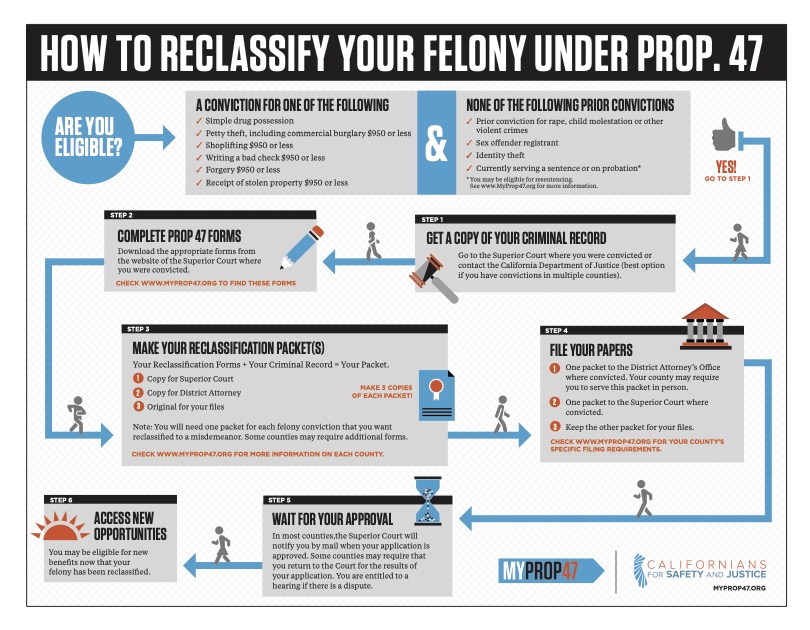
On November 4, 2014, California voters passed Proposition 47, a law that changed certain low-level crimes from potential felonies to misdemeanors. The savings from reduced incarceration costs will be invested into drug and mental health treatment, programs for at-risk students in K-12 schools, and victim services.

Individuals with a prior felony record for any of the following low-level, nonviolent offenses or who are currently serving time for the following crimes may qualify to change their record or their sentence to a misdemeanor:

  • Simple drug possession
  • Petty theft under $950
  • Shoplifting under $950
  • Forgery under $950
  • Writing a bad check under $950
  • Receipt of stolen property under $950

Changing Your Felony

Individuals who are currently incarcerated for offenses committed in the state of California that are impacted by Proposition 47 can seek to be re-sentenced and released (this is known as re-sentencing). Click here for more information on the resentencing process.

Individuals who have been previously convicted of these felonies for crimes committed in the state of California can apply to have them changed on their record to misdemeanors (this is known as reclassification). Removal of a felony record can reduce immigration consequences and help remove barriers to jobs, housing and stability.  Click here for more information on the reclassification process.

Community Investments

One of Proposition 47’s most promising opportunities is the reallocation of corrections funding to crime prevention and treatment. An independent state agency projects that Proposition 47 will produce hundreds of millions of dollars annually in savings at both the state level and among California’s counties.

Proposition 47 allocates savings in state prison costs to mental health and drug treatment programs at the community level, programs for at-risk K-12 students, and trauma recovery services to help victims of crime. State and local officials must help ensure that savings in state or county justice systems are reallocated to community-based treatment and prevention. Counties should also experience criminal justice cost savings and can allocate these savings as they see fit.

$68 Million in Proposition 47 savings for 2016-2017 fiscal year
The 2016-2017 budget adopted by the state legislature and signed by Gov. Jerry Brown shows Prop. 47 is making good on its promise to save tens of millions of dollars annually that will be reallocated to community-based crime prevention programs. Included in the budget is nearly $68 million in funding for Proposition 47 investment programs, including drug and alcohol rehabilitation, mental health treatment, trauma recovery services for victims of crime and truancy and dropout prevention programs for at-risk schoolchildren.

(Information provided by myprop47.org)


Root & Rebound’s mission is to transfer power and information from the policy and legal communities to the people most impacted by our criminal justice system through public education, direct legal services, and policy advocacy, so that the law serves, rather than harms, low income communities and communities of color in the United States. For more information, click here.

Link to Root and Rebounds Reentry kit. Click here


Areas of assistance: Career Technical Education, Reentry Services, Restorative Justice

Types of assistance: Over 20 vocational training programs which include financial literacy, construction, masonry, print shop, pet grooming, hospitality/food service industry, training programs in basic computer software programs, nonprofit management training, training programs in horticulture, green building and construction. Transitional needs assessment, reentry coordinators to assist in placing the formerly incarcerated into reentry programs outside of jail. Ongoing peer-to-peer support for returning citizens and first time attendees receive a backpack with reentry supplies (clothing, toiletries). They also offer a for-credit restorative justice class.

Location: 2420 E. 1st Street, Los Angeles, CA 90033

Contact: Phone-(323)685-2782, Fax-(415)734-3314

Website: Five Keys schools and programs

Areas of assistance: General Relief Opportunities for Work (GROW), Cal Fresh (Food stamps) Expungement, Vocational assessment, Educational Services, Mental health services, Substance abuse services.

Types of assistance: Once you become a participant in their GROW program you become eligible for various services. They provide education/ training for participants who want to pursue further education and training to realize their employment goals. If a participant needs to get their High School Equivalency Certificate the individual may choose any accredited school and GROW will pay the fee to take the exam. Grow can assist in helping expunge convictions from your record. They provide supportive services for victims of domestic violence and those mental health disorders to help them overcome barriers to employment. If a participant declares a need for substance abuse services the GROW program staff will ensure that assistance is provided.

Location: 2601 Wilshire Blvd., Los Angeles, CA, 90057

Glendale office: 4680 San Fernando Rd. Glendale, CA 91204

Contact: (866)-613-3777, (818)-701-8200

Website: Los Angeles County DPSS

Areas of assistance: Apprenticeship Preparation Program, Career Preparation Program, Know Your Rights Training, Record Change Clinics, Reintegration Network.

Types of assistance: The Apprenticeship Preparation Programs prepares formerly incarcerated for careers in the construction trade by providing them with information, experience, and skills necessary in the field. The main components of the program are case management services and a nationally union-approved course (MC3). The program also helps prepare participants to obtain and retain employment by providing life skills, training, employability training, hands on volunteering with Habitat for Humanity, union site visits, and guest speakers.

The Career Preparation Program assists formerly incarcerated through in-depth training on resume writing, searching for jobs, interviewing, retaining employment, and other key employability skills. Participants can also work with educators from the Pasadena Unified School District to earn their GED or high school equivalency.

Record change clinics are hosted to help those formerly incarcerated who are eligible to expunge their past offences by helping them navigate and process the paperwork.

Reintegration Network consists of local service providers and public agencies working together to meets needs of formerly incarcerated. They help participants set goals and make plans, navigate complicated processes to get social services, and complete necessary steps to successful reintegration, such as driver’s license, finding housing and employment, paying child support, and more.

Location:  235 West Mountain Street, Suite 106, Pasadena, CA 91103

Contact: Phone: (626) 449-0839, Email: info@flintridge.org

Website:  Flintridge Center

Areas of assistance: State Licensing Board Discipline and Revocation Appeals, Proposition 47 Outreach & Petition Filing, Expungement Services, Termination of Probation and Felony Reduction Petition Reduction Petition Filing, Traffic Ticket Amnesty/DMV negation and support

Types of assistance:  Provides individuals affected by past criminal justice involvement may receive free legal representation. Those who have lost their license (nursing) may be helped with appeals. If you have been convicted prior to the passing of Proposition 47 you may have your felony convictions reduced to a misdemeanor. Expungement services are available for those eligible under the California Penal Code 1203.4 and 1203.4(a). Representatives can help those eligible to have their probation terminated. Felony reduction petition filing is also available.

Location: 919 Albany St, Los Angeles, CA 90015

Contact: Phone: (213) 736-8339, Email: cjlp@lls.edu

Website: Collateral Consequences of Convictions Project

Areas of assistance: Substance abuse treatment and recovery (STAR), Computerized literacy learning centers (CLLC), Parole education programs (PEP), G.E.D. services, vocational preparation.

Types of assistance: Parole education programs are located in parole offices throughout the state along with computerized literacy learning centers which offer adult basic education in reading, writing, math, G.E.D., and literacy. The STAR program is a curriculum designed to help parolee substance abusers develop new skills to understand the relapse process and prepare for a smooth drug free community transition.

Location: CLLC/STAR Sites- San Fernando Valley Van Nuys Parole: 8100 Balboa place, room 102, Van Nuys, CA 91406. PH:818-442-0544

South Central Parole: 2444 S. Alameda St., Los Angeles, CA 90058. PH:323-238-1630

Sunset DRC Behavioral Systems Southwest: 1000 West Sunset Blvd. #100, Los Angeles, CA 90012 PH: 213-259-8467

Contact: 925-942-3388

Website:  Contra Costa County Office of Education


Areas of assistance: Emergency services, Residential rehabilitation, Urban training institute, re-entry residential program.

Types of assistance: The primary emergency services are offered to anyone in need free of charge and include 3 hot meals daily, overnight shelter, clean clothing, showers, mail services and employment assistance. The residential rehab program offers education assessment and placement, career and job services, life skills courses, academic courses, mental health recovery services, psychiatric referrals and other referral services. Their urban training institute offers classes in adult basic education, computer literacy classes, G.E.D. readiness classes, standardized test preparation, computer fundamentals, on-line courses, customer service, tutoring, ESL, and also provide classes on anger management and domestic violence.

The break it to make it residential re-entry program is in partnership with the Strindberg Laboratory and Los Angeles City College and their goal is to break the “prison-street-prison” from the lives of individuals released from incarceration. You may enroll into any of 3 programs depending on your unique needs including Fast Track and Life start which are 6 month programs and the Fresh Start program which is 12 months. 30 days prior to your release from jail a team of counselors will do an intake assessment and will arrange transportation for you to arrive at L.A. Mission. This program offers case management, housing, food, legal assistance, education, spiritual support, substance abuse and mental health counseling, job training, job/career development, community support system.

Location: 303 East 5th St., Los Angeles, CA, 90013

Contact: 213-629-1227

Website:  The Los Angeles Mission

Areas of assistance: Mental Health Services Continuum Program

Types of assistance: Parolees may receive cost effective mental health services such as evaluating mental illnesses, group therapy, crisis intervention, and case management. Housing subsidies may be available to parolees who suffer from severe mental illnesses and are at risk for homelessness

Contact: Division Headquarters Telephone: (916) 445-6200

Website:  D.A.P.O/CDCR (Department of Adult Parole Operations)

Areas of Assistance: Employment Services, Employment preparation, Job development, job coaching, mental health services, Education assistance.

Types of Assistance: DOR will assist our formerly incarcerated students with various types of services to allow them to pursue education. They will help with purchasing text books, parking passes, school supplies, tuition, transportation stipends and various other forms of support. This is an extremely helpful resource for students.

Location: 425 W. Broadway Ste#202, Glendale, CA 91204

Contact: Nancy Peera 818-551-2141

Website: Department of Rehabilitation (DOR)


Areas of assistance: Tattoo removal, workforce development, Education services, legal services, mental health services, solar panel installation training and certificate program.

Types of assistance: Homeboy industries offers tattoo removal to those enrolled in the homeboy program or community clients. Their workforce development provides weekly workshops on overcoming employment barriers and how to find hidden job markets. They also provide job seeker workshops on how to build resumes and prepare for job interviews. There is also job placement assistance for trainees and community clients. They have a great team of volunteer attorneys who provide free consultations and referrals. They also assist clients petition for dismissals and expungements to reduce barriers to employment. Clients also receive substance abuse and psychiatric counseling along with other mental health services. They cover tuition and supply costs for homeboy clients who wish to enroll in the photovoltaic training program at East Los Angeles skills center which is a 4-month full time program.

Location: 130 W. Bruno St., Los Angeles, CA 90012

Contact: 323-526-1257

Fax: 323-526-1257

Email: info@homeboyindustries.org

Website: Homeboy Industries


The Anti-Recidivism Coalition (ARC) empowers formerly and currently incarcerated people to thrive by providing a support network, comprehensive services, and opportunities to advocate for policy change.

ARC serves more than 450 formerly incarcerated men and women, who commit to living crime-free, gang-free and drug-free; enrolling in school, working, or actively searching for work; and being of service to their community. The majority of ARC members live in Los Angeles County, where the organization was founded. Over the past three years, ARC has expanded its network to also include members in Orange, Riverside, and San Bernardino Counties, as well as Sacramento and the San Francisco Bay Area. In September 2016, ARC opened a second office in Sacramento County, and is now providing reentry and supportive services to more than 130 formerly incarcerated young people in the region. For more information, click here.


The Clinic will provide free legal representation to individuals with past criminal justice involvement to assist them in navigating and overcoming many of the collateral consequences of conviction with the goal of facilitating successful reintegration into society.
  • The Project will offer the following services:
  • State Licensing Board Discipline and Revocation Appeals
  • Proposition 47 Outreach & Petition Filing
  • Expungement Services (California Penal Code 1203.4 and 1203.4(a))
  • Termination of Probation and Felony Reduction Petition Filing, where appropriate
  • Traffic Ticket Amnesty (before sunset date)/DMV Negotiation and Support, where appropriate

By removing these significant barriers to employment and other areas, the Project will assist formerly incarcerated Angelenos secure employment, self-sufficiency and stability

Loyola Law School Letter (pdf)